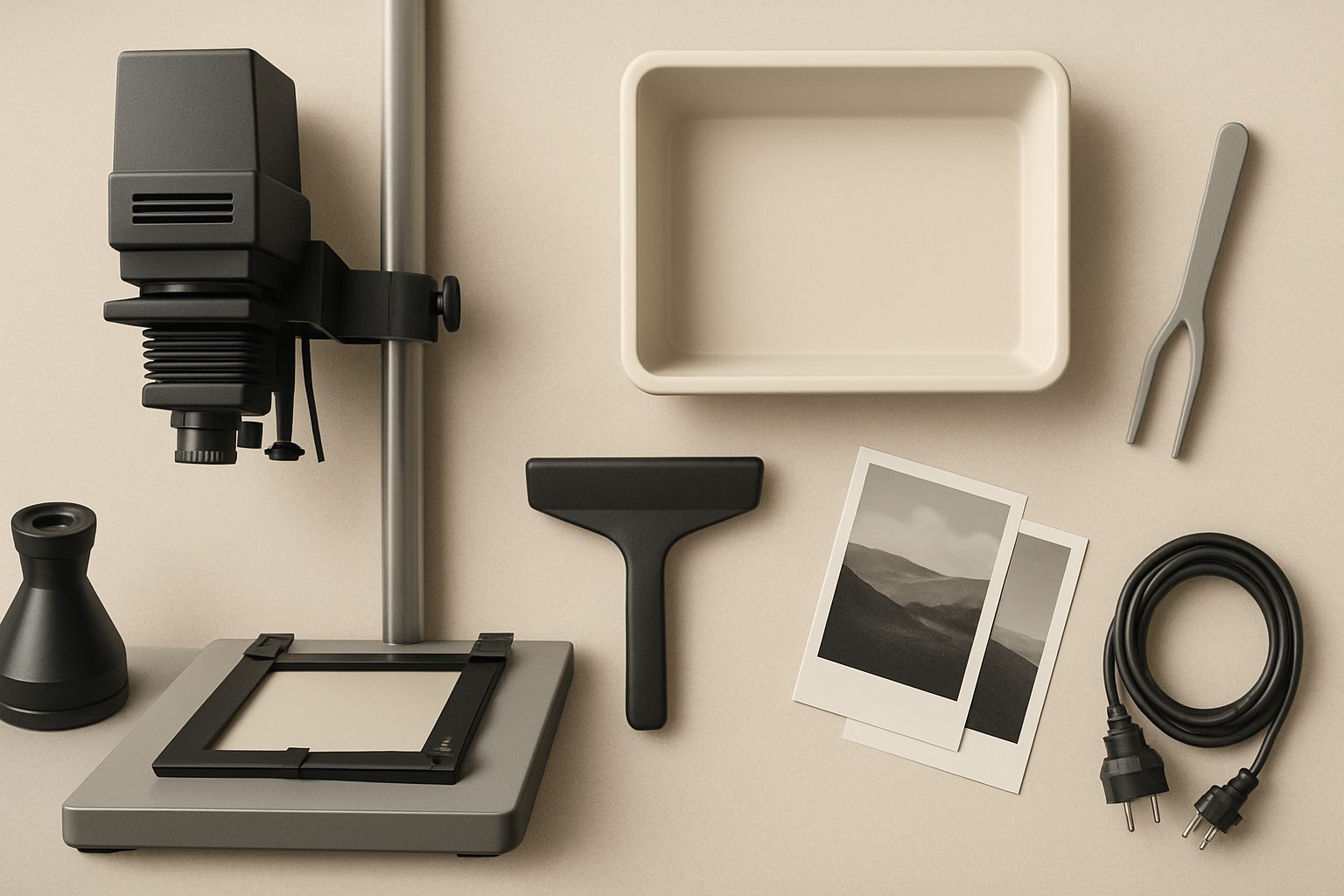
Best Darkroom Enlargers for Large Format Printing UK — 4×5 & Beyond
Large format darkroom printing sits at the pinnacle of analogue photography. Working with 4×5 negatives — or larger — produces prints with exceptional detail and tonal range, but requires an enlarger designed for the job. Standard 35mm enlargers simply can't handle the weight and optical demands. If you're serious about large format darkroom work in the UK, you need to understand which machines will actually deliver the precision and reliability you've paid for in your film and chemistry.
Why Large Format Enlargers Matter
A 4×5 negative contains roughly 13 times the image information of 35mm. That density demands an enlarger with rock-solid stability, precise focusing, and excellent optical performance. Consumer-grade machines sag under the weight of large format negative carriers, vibrate during printing, and lose focus between test strips and final prints. You'll waste time, paper, and chemistry chasing focus rather than perfecting exposure and contrast.
The enlargers that matter for serious large format work have been refined over decades. They're heavy, they're built to last, and they're still available in the UK — though sourcing has become trickier since analogue darkroom use contracted.
The Durst L1200
The Durst L1200 is the modern workhorse for large format darkroom printing. Built in Italy and distributed across Europe until the early 2000s, it handles 4×5 negatives with ease and will comfortably manage 5×7 if your masking system allows it.
The L1200 features a substantial cast-iron chassis with column bracing that resists vibration. The light source is a 250W quartz lamp with integrated heat filter — adequate for most darkroom work, though some users upgrade to LED systems for cooler running. Focusing is manual via a screw-drive mechanism on the baseboard; this gives you tactile control and doesn't require electronics to fail.
The standard lens is a 150mm Durst Componon, and the system accepts lenses up to 210mm. Negative carriers are straightforward to swap between formats. Build quality is genuinely excellent; finding a 30-year-old L1200 still in regular use is common.
The main drawback: the L1200 is not designed for quick format changes. If you regularly switch between 35mm and large format work, you'll find the reconfiguration tedious. Second-hand prices in the UK are rising as demand exceeds supply. Expect to pay £1,200–£2,000 for a clean example with full carrier set.
The Leitz Focomat IIC
The Leitz Focomat IIC is the precision option for serious darkroom printers. Built by Leitz in Germany, this is a machine for photographers who value absolutes: perfect alignment, repeatable focus, and optical perfection.
The Focomat IIC uses a motorised vertical focus, which means you can achieve exacting focus control — critical when you're working with minimal depth of field in the dark. The optical path is engineered to keep the negative plane and baseboard precisely parallel, reducing keystoning errors. It accepts 150mm and larger lenses without issue.
The Focomat is undoubtedly the most expensive option in this range. Second-hand examples command £2,500–£3,500 in the UK, and they don't depreciate significantly. This is a machine you buy once and use for 30 years. Maintenance is straightforward; Leitz built in accessibility and parts availability remains reasonable through specialised dealers.
The trade-off is complexity. The motorised focus is powerful but introduces another system to learn and occasionally troubleshoot. For hobby printers, the Durst L1200 often delivers 90% of the Focomat's precision for half the cost.
The Omega D2
The Omega D2 is the budget-conscious entry point to large format darkroom printing. American-built and widely imported to the UK during the 1970s and 1980s, it remains surprisingly capable for 4×5 work.
The D2 is simpler than the Durst or Leitz machines. The cast chassis is lighter, the optical bench is straightforward, and the manual focus mechanism is rugged. You'll find D2s reliably printing fine detail from 4×5 negatives even after 40+ years of use. The build is less refined than the Durst, but it's durable and easy to repair if something breaks.
The principal limitation is rigidity under weight. The D2 will sag slightly when loaded with a large format negative carrier and heavy lens. It's noticeable on prints larger than 16×20, where fine focus becomes marginal. For prints up to that size, the D2 is perfectly serviceable.
Second-hand pricing reflects the Omega's simplicity: £600–£1,200 for a working example. Lenses are readily available in the used market, and the standardised Omega lens mount means you're not locked into Omega optics.
Lenses for Large Format Enlarging
A 150mm lens is the minimum focal length for 4×5 enlargement. It's short enough to allow decent image magnification on standard baseboard heights, yet long enough to provide adequate working distance for even lighting.
A 180mm or 210mm lens is preferable if your baseboard or wall height allows. Longer focal lengths reduce edge falloff and provide more even illumination across larger prints. They cost more (used 180mm lenses run £300–£600), but the image quality improvement is real.
Always buy apochromatic or carefully corrected enlarging lenses. Cheap lenses introduce chromatic aberration and soft edges that no amount of careful focus will fix.
Sourcing in the UK
Large format enlargers are increasingly scarce in the UK. eBay is the primary source, though prices have inflated 30–40% in the past four years as darkroom interest has resurged. Specialist dealers like Peak Cameras and Redux Darkroom occasionally stock machines, but inventory turns slowly.
Import from EU markets is viable; German and Italian dealers hold better stock than UK sellers. Account for shipping costs and EU import procedures if you consider this route.
Verify mechanical condition before purchasing. Rust in the lamp house, wobbling baseboard, or frozen focus mechanisms are expensive to repair. Always test the enlarger with a dummy load before committing.
Large format enlarging demands precision equipment, but the rewards in print quality justify the investment. Choose based on your realistic printing ambitions and budget — any of these three machines will give you decades of reliable use.
More options
- Darkroom Enlargers (various brands) (Amazon UK)
- Enlarger Lenses (El-Nikkor, Rodagon, Componon-S) (Amazon UK)
- Darkroom Timers & Exposure Meters (Amazon UK)
- Ilford Multigrade Darkroom Paper (Amazon UK)
- Darkroom Starter Kits & Accessories (trays, easels, chemicals) (Amazon UK)